Remember the old Johnny Carson quiz show...you know the one he had before he became famous? Sheesh...am I dating myself...anyway, that's the phrase that came to be because of the collect for this Sunday. And then, of course, with the ubiquity of politics, the question seems timely...here then based on the reading below is today's sermon...September 7, 2008
Who Do You Trust?
The Democratic and Republican conventions are now over…you may cheer if you wish. So now the question comes to us; “Who do you trust with your vote.” That is certainly a question of consequence. It is a question of importance. The nation is at war and our economy is in a down turn, the credit markets and especially the mortgage markets are in nothing short of crisis mode. It appears that the Federal Government is poised to rescue both Freddie Mac and Fannie those quasi governmental agencies that were supposed to guarantee affordability of housing to the average American. Now it appears that some questionable mortgage writing practices have put millions into a foreclosure mode. Thus how we vote will matter significantly. Mind you, just as a cautionary note; even the candidate of your choice may not be able to keep all the promises he or she makes. Surprise!
So that brings us back to the question; “Who do you trust?” Today’s collect begins with these words; “Grant us, O Lord, to trust in you with all our hearts” When we think of the question of trust, we quite naturally think of loved ones, but not always politicians and used car salesmen. There are so called “Trust” companies, but that’s a different kind of trust. There are clergy, some of those can be trusted, but we’ve seen examples where our trust can be put to the test even there. There are teachers, members of the extended family, there’s the boss, there’s co-workers, and then there’s my best friend. It is good to be back here at the altar and in this pulpit after a nice vacation period. I feel a kinship and a friendship growing between us. I feel that the very trust of friendship growing between us.
We are now half way through our contract dates…some of us are beginning to ask what of that period…and what happens then? In all cases, there are a variety of ways in which we can gauge our trust levels. It takes a while for instance for a priest and a congregation to build up trust levels to the point where we can really move ahead together and get serious about setting forth the praise of Almighty God through our service to our community and those in need. It takes time. And it doesn’t take much for that trust to be broken or to be put to the test.
Before we get to that question though, we continue on task to do what God formulated in our early conversations
1. First to continue the work of healing among our people and to recruit into this fellowship those committed to the mission of this church.
2. Secondly to live into our mission statement; to be “A house of prayer for all people”,
3. And thirdly to find a way to make ourselves good stewards of all that God has given this church; and that before the end of our three year contract to make significant progress to become a self supportive congregation, joyfully generous to the point that our budget is balanced and focused not on survival but on mission.
God has called us into relationship. God has built a goodly level of trust between us and thus we now enter into this new season and we continue to celebrate this congregation’s 275th Anniversary.
Our history as a people of God goes back much further than just the history of this church. Think of the faith of our ancestors and how that was put to the test. They fled the Egyptian army in haste and Moses stretched out his arms and the Red Sea parted and the children of Israel walked on dry land as the waters stood up like two tempestuous walls one to the right and the other to the left. The children of Israel were free. And Pharaoh’s chariots sank into the depths like a stone. So far; so good! Ah but then the reality of wandering aimlessly in the desert for 40 years began to set in. And the faith of the people in God and in Moses was put to the test. The people murmured and complained in the hearing of God and in the presence of Moses. And the patience of both was put to the test. And yet out of the fullness of that life together God’s law grew in the people’s hearts…the concept of justice grew and the trust of God and God’s people for one another also grew. It is in the crucible of that history that we became the people of God. And so the first lesson teaches us to remember what God has done in our lives. The Passover of the Lord is that memorial and this Eucharist is the Passover over of Chist who was sacrificed for us.
So as we learn the message of trust we learn likewise to honor God’s law and in doing so, to owe nothing to one another but to love one another. This is the fulfillment of all God’s law. First to love God and likewise to love one another. Those two commandments are not just like one another they are congruent with each other. It is in the reality of that love that we thus form a deep and abiding trust of one another and God.
So what then do we do when that trust is broken? Folks that are very close to us can break our trust, so can those in more formal relationships. Jesus gave us clear directions on that one. If somebody causes an offense against you, you then must bring that offense to the attention of the one who committed it. Ninety percent of the time a direct and forthright conversation will win over the offender. With a bit of patience, inner self control and prayerful wisdom, this stratagem will most often effect the reconciliation and restoration of trust so necessary in a world so beset with alienation.
We don’t always to this. It is often easier to talk about someone than it is to talk to that very person. This can be someone we love very much. Something in our own insecurity causes us to feel very vulnerable to direct and honest conversation. And so rather than be reconciled to our loved one we allow the distance between us grow even further apart. Alienation takes hold and grows by the hour.
In a community of the people of faith this is not how we act toward one another. Instead the husband says to the wife; you know we have to talk. The friend says to his or her best friend, want a cup of coffee…or maybe I’ll buy you a drink. Maybe you can even begin with an apology and take the high road…how often that wins the soul.
The winning of the soul also wins the practice of the presence of God. For in that truth, in that moment of coming together and reconciliation, in that time where forgiveness once again overcomes guilt and unity overcomes estrangement, it will always be in a moment like that when God becomes palpably real. For when two or three are gathered together in God’s name…there Jesus is too.
So who do you trust? I know who I trust in the current political campaign. But I’m not saying who right here and right now. You’ll have to drag that out of me…kicking and screaming. There are any number of people I trust, because we have forged strong relationships over the years based on an honest sharing of our deepest experiences. The more we practice this kind of life, the more we come to know that God is indeed in our midst.
So who do you trust today?
Sunday, September 07, 2008


Monday, September 01, 2008
A new season is upon us
Next Sunday we begin a new season in our journey together as priest and people. I do hope to see you all in church of course.
As we prepare for the new season lets also discipline ourselves to remember that we are all students of Jesus, The Teacher and of the record we have of his life among us.
As we enter the new season we do so, of course, with the sacred writings of the ancients as our guide.
They too are our companions along the way.
As they looked into their experiences and their lives, they saw God's life living and breathing within their hearts.
We shall do nothing less.
Here then are the readings for next Sunday.
Have a look, and then next week we'll see where all this takes us.
In Sunday's lessons we'll hear about the significance of marking a memorial of God's Passover in the run up to the liberation of Israel from slavery. That permanent memorial will in history mark the liberation of all peoples from every form of slavery. It will factor significantly in American history. It was at the center of Christ's redeeming work in freeing us from the bonds of sin and death.
The Psalm sings a new song to God. We'll be singing a new creed on Sunday. It is a wonderful melody. As we learn our new songs, we also learn how to sing of our love for God and one another in our hearts on a daily basis.
Paul continues the theme by inviting us to owe nothing to one another except the love we are bound to bear to one another. We discover this kind of love as we put off the works of darkness and take on the deeds of the light. Thus we put on Christ as we would any fine garment, and our lives become adorned with something beautiful for God.
The Gospel is an interesting redactor. Still the authority of Jesus is clear, however you want to date the passage...if someone sins against you, first talk to that person. Let's face it, it is easier to talk about someone than it is to talk to them directly. When we do, we almost always win their hearts. But not always. Conflict occasionally runs deep. In cases where that is so Jesus would have us take our case to "arbitration", and if that fails to the whole church. If that doesn't work even then...well...treat them like you would a sinner or a tax collector.
And so how does Jesus treat sinners and tax collectors?
Ah, you get the point!
See you all Sunday.
Fr. Paul
The Lessons Appointed for Use on the
The 17th Sunday After Pentecost
Proper 18
Year A
RCL
Grant us, O Lord, to trust in you with all our hearts; for, as you always resist the proud who confide in their own strength, so you never forsake those who make their boast of your mercy; through Jesus Christ our Lord, who lives and reigns with you and the Holy Spirit, one God, now and for ever. Amen.
Exodus 12:1-14
The LORD said to Moses and Aaron in the land of Egypt: This month shall mark for you the beginning of months; it shall be the first month of the year for you. Tell the whole congregation of Israel that on the tenth of this month they are to take a lamb for each family, a lamb for each household. If a household is too small for a whole lamb, it shall join its closest neighbor in obtaining one; the lamb shall be divided in proportion to the number of people who eat of it. Your lamb shall be without blemish, a year-old male; you may take it from the sheep or from the goats. You shall keep it until the fourteenth day of this month; then the whole assembled congregation of Israel shall slaughter it at twilight. They shall take some of the blood and put it on the two doorposts and the lintel of the houses in which they eat it. They shall eat the lamb that same night; they shall eat it roasted over the fire with unleavened bread and bitter herbs. Do not eat any of it raw or boiled in water, but roasted over the fire, with its head, legs, and inner organs. You shall let none of it remain until the morning; anything that remains until the morning you shall burn. This is how you shall eat it: your loins girded, your sandals on your feet, and your staff in your hand; and you shall eat it hurriedly. It is the passover of the LORD. For I will pass through the land of Egypt that night, and I will strike down every firstborn in the land of Egypt, both human beings and animals; on all the gods of Egypt I will execute judgments: I am the LORD. The blood shall be a sign for you on the houses where you live: when I see the blood, I will pass over you, and no plague shall destroy you when I strike the land of Egypt.
This day shall be a day of remembrance for you. You shall celebrate it as a festival to the LORD; throughout your generations you shall observe it as a perpetual ordinance.
Psalm 149 Page 807, BCP
Cantate Domino
1
Hallelujah!
Sing to the LORD a new song; *
sing his praise in the congregation of the faithful.
2
Let Israel rejoice in his Maker; *
let the children of Zion be joyful in their King.
3
Let them praise his Name in the dance; *
let them sing praise to him with timbrel and harp.
4
For the LORD takes pleasure in his people *
and adorns the poor with victory.
5
Let the faithful rejoice in triumph; *
let them be joyful on their beds.
6
Let the praises of God be in their throat *
and a two-edged sword in their hand;
7
To wreak vengeance on the nations *
and punishment on the peoples;
8
To bind their kings in chains *
and their nobles with links of iron;
9
To inflict on them the judgment decreed; *
this is glory for all his faithful people.
Hallelujah!
Romans 13:8-14
Owe no one anything, except to love one another; for the one who loves another has fulfilled the law. The commandments, "You shall not commit adultery; You shall not murder; You shall not steal; You shall not covet"; and any other commandment, are summed up in this word, "Love your neighbor as yourself." Love does no wrong to a neighbor; therefore, love is the fulfilling of the law.
Besides this, you know what time it is, how it is now the moment for you to wake from sleep. For salvation is nearer to us now than when we became believers; the night is far gone, the day is near. Let us then lay aside the works of darkness and put on the armor of light; let us live honorably as in the day, not in reveling and drunkenness, not in debauchery and licentiousness, not in quarreling and jealousy. Instead, put on the Lord Jesus Christ, and make no provision for the flesh, to gratify its desires.
Matthew 18:15-20
Jesus said, "If another member of the church sins against you, go and point out the fault when the two of you are alone. If the member listens to you, you have regained that one. But if you are not listened to, take one or two others along with you, so that every word may be confirmed by the evidence of two or three witnesses. If the member refuses to listen to them, tell it to the church; and if the offender refuses to listen even to the church, let such a one be to you as a Gentile and a tax collector. Truly I tell you, whatever you bind on earth will be bound in heaven, and whatever you loose on earth will be loosed in heaven. Again, truly I tell you, if two of you agree on earth about anything you ask, it will be done for you by my Father in heaven. For where two or three are gathered in my name, I am there among them."
Saturday, August 30, 2008
Please Pray For those in the Path of Gustav
Dear friends,
Please keep the folks in the Gulf Coast in your prayers. Another dangerous storm is aiming for the Gulf Coast and by all indications will be very powerful, and looks to make a direct hit on New Orleans. The storm is currently located near Havana, Cuba. Our brothers and sisters of that island nation also need our prayers. The Bishop of Louisiana has mobilized the Office of Disaster Response into a state of full readiness and is preparing to close churches and order an evacuation. The Diocese has made this plea to all government officials: "In all of these efforts, we are mindful of the poor, the homeless, those in temporary lodging, and those without the capacity to care for themselves. We urge our leaders and officials to honor the dignity of each person, especially in the event of a disaster. We remind all that we are not disposable people. The faith communities will hold ourselves and our officials to a high degree of accountability and transparency in this time of uncertainty."
I ask your prayers in particular for Walter Baer and the folks of Grace Church, Canal Street in New Orleans.
For Catherine Hancock, and her family
and the Priest and People of St. Mark's in Gulfport, MI,
All of whom some of us have developed strong bonds of affection since Katrina.
To stay abreast of developments use www.nola.com (News of New Orleans) and www.edola.org (News of the Diocese of Louisiana)
Thank you for your love and prayers. Those of you wishing to respond to the unfolding disaster may use the Episcopal Relief and Development Fund as a vehicle for sharing your love and generosity. The website is http://www.er-d.org/
Thank you all.
Fr. Paul
Friday, August 08, 2008
A few days in Maine


Cindy and I were able to take a few days in Maine for some rest and refreshment. The surroundings were amazing. Here are a few photos.
Reflections on Lambeth...by Jack Spong
I could not have said it better....
Homophobia - No Compromise Possible
I recently listened to a series of insightful lectures on the American Civil War given by Dr. Gary Gallagher, a professor of History at the University of Virginia. Early on, Dr. Gallagher analyzed the failure of America's political leadership to find a compromise on slavery in the days and years leading up to secession and the catastrophic and bloody war. There was the careful attempt to admit to the Union, in tandem, one slave state and one free state to insure the balance of power in the Senate. Henry Clay of Kentucky, the "great compromiser" helped to work out the division of Western territory so that this balance was to be preserved "in perpetuity." Slavery, however, was not a political battle that could ultimately be negotiated; it was rather a moral battle that did not lend itself to compromise. It pitted a new consciousness against a dying definition. Slavery could not be partially moral or moral under some circumstances. It was either moral or immoral. There was no middle ground.
In the slavery debate, those who shared the new consciousness were quite clear. Human beings cannot be held in bondage. This new consciousness challenged those definitions, which suggested that some people did not qualify as human beings; that some people were primitive, childlike, created to be subservient, and were, therefore, fit for nothing other than manual labor. Within that definition, slavery was deemed to be morally acceptable and those who held this position actually believed that slavery was virtuous, since the slaves were assumed to be receiving the benefits of better health, longer life and wonderful new opportunities in "a civilized and Christian land." These arguments sound strange, even hostile, to us today but ideas of racial superiority were still a powerful force in the Western world as late as the 20th century, fueling World War II, that cost the lives of over one hundred million people.
I thought about this period of history as I read of my own church, the Anglican Communion, seeking a way, "for the sake of unity," to accommodate divergent opinions on the issue of homosexuality. The Church's leadership is acting as if negotiation is possible in this conflict, yet the obvious fact is that homosexuality, like slavery, is a moral issue and thus not amenable to compromise. Once again today's debate pits an emerging consciousness against a dying definition. The old definition asserts that homosexuality is a choice that evil, perverted or subhuman people make. It cannot, therefore, be tolerated. People whose depravity causes them to choose "this lifestyle" must be converted or removed lest they destroy the social order; if they are homosexual because of a mental illness, they must be cured or isolated lest they infect the health of all our citizens. That is the definition, stated honestly but more baldly than its proponents will appreciate, that is held by those who call themselves conservative or traditional Christians. I suspect, based on the results of our recent election, that they are a majority in the body politic of America at this moment. They are, however, a frightened majority because every statistical study indicates that this point of view is declining. To defend this position by claiming that the refusal to accept this perspective will destroy "the unity of the Church," is a breathtakingly bankrupt idea. Trapped inside dying definitions, these Christians assume that not to agree with them places their critics on the side of immorality and moral anarchy.
The emerging new consciousness, on the other hand, rejects every part of that definition. It asserts that homosexual people are neither morally depraved nor mentally sick, since one's sexual orientation is not a choice; but something to which one awakens. It is like the dawning realization that one is male or female, part of a particular race or nation or even right or left-handed. A just and moral society cannot be erected on a premise that some human beings are subhuman or perverted, not on the basis of their doing but on the basis of their being. It matters not what any source of ancient wisdom has previously declared. The Bible, for example, was once quoted to support slavery, to oppose science and to prevent women from achieving equality. On every one of those issues the Bible was quite simply wrong. To quote it now to uphold the evil of homophobia is no less wrong. These efforts will fail as they always do. The ultimate tragedy is, however, that some church leaders, ever on the wrong side of great moral questions of history, never seem to learn history's lesson that any prejudice once publicly challenged by a new consciousness is doomed.
As I survey the debate on this issue in all parts of the Christian tradition, a tragic failure of leadership is once again depressingly obvious. The Roman Catholic hierarchy simply takes the old definition and labors first to defang it and then to perfume it. They call homosexuality "unnatural," or "a deviation," urging that it be suppressed wherever possible and controlled where not possible. Homosexuality, however, has now been incontrovertibly identified as present in the world of higher mammals. It also appears to be a stable and unchanging percentage of the human race at all times and in all places. These data suggest that homosexuality is not unnatural at all but is a minority aspect of the created order that appears quite normally in all higher forms of life. Furthermore, this negativity in the Roman Catholic tradition is without character since it is both known and privately acknowledged that a major percentage of Roman Catholic clergy throughout history, including today, have been and are gay males. To watch the leaders of this church condemn that which is a fact in the lives of its cardinals, bishops and priests is either dishonest or an act of unconscious psychological denial.
The evangelical and fundamentalist churches proclaim that these definitions of antiquity embody the eternal truth of God and any attempt to change them is either the work of Satan or a godless secular spirit that is challenging the word of God in the name of immorality. Yet the new consciousness is dawning there too. As long ago as 1988, the Southern Baptist Convention voted by over a 90% majority to "reaffirm" its condemnation of homosexuality as "behavior repugnant to God" and "condemned by scripture." They seemed not to recognize that any definition that has to be reaffirmed is no longer holding. The only questions are how protracted will the debate be and how many people will be hurt before that prejudice dies. When anyone seeks to protect a dying definition, failure is inevitable.
The leaders of the mainline churches, aware of the new consciousness, pretend that some compromise is possible. They seek to protect unity by attempting to civilize the debate until a new consensus arrives. They count "the unity of the church" as a worthy goal even as that forced unity violates that Institution's integrity. Can you imagine that part of the Church that said no to slavery being asked to apologize for upsetting the consciences of the slaveholders? Can you imagine Church leaders saying to slaveholders, "we will not challenge the morality of your decisions about slaves because we would rather keep our faith community united?" Can you imagine coddling slaveholders so that they will not separate themselves in schism from the Church? Can anyone imagine any slave-holding church claiming to be the body of Christ?
Yet if you substitute the word homosexuality for the word slavery, that is what is present today in the main line churches. If homosexuality is a given not a chosen way of life, the continued violation of gay and lesbian people, in order to preserve unity with the Church's homophobic constituency, is simply immoral. Not to bear corporate witness to those who still languish in the dying definitions of the past is to turn one's back on the very meaning of the Christ. Do we imagine that Jesus' invitation was, "Come unto me, some of ye." instead of "Come unto me, all ye?" Can any Church discriminate against any child of God and still sing, "Just as I am, without one plea, O Lamb of God, I come"?
Slavery could not be compromised in the 19th century because slavery was finally understood as a moral issue. Homosexuality cannot be compromised in the 21st century because it too is a moral issue. To the threats of parts of the Christian Church to leave if homosexual people are welcomed fully without any distinction, the body of Christ must be prepared to say, "That is your choice but we do not compromise truth to comfort you in your prejudice. The Church's doors will be open when your consciousness is finally formed and you decide to return, but we will not reject homosexuals now to avoid offending you. If the essence of our Christ is summed up in words that John's Gospel attributes to him, "I have come that they may have life and have it abundantly," then the choice is clear. Homophobia diminishes life; it does not make it more abundant. It must be ended; it cannot be tolerated even by making it kinder and gentler.
To the leaders of the Churches today I say: "Stop playing ecclesiastical games. Compromising truth never serves the cause of unity. The call of Christ is not to be all things to all people. The time for negotiating and compromising is over. It matters not if you are the Pope, the Archbishop of Canterbury or one of the heads of the various national and international bodies of Christians around the world, both the moral integrity of the Christ you claim to serve and your ability to speak for Christ on any other issue are at stake. There is no room for waffling on this moral imperative. The idea that you will allow politicians to advocate placing discrimination against homosexual persons into the Constitution of this country, while your voices are either in agreement or remain deafeningly silent, is an embarrassment. If it takes a split in the body of Christ to make this generation understand that homosexuality, like slavery, is a non-debatable, moral issue, then for God's sake, for Christ's sake, you must be willing to pay that price."
Tuesday, July 29, 2008
Awwww....puffin....
When our children were little, I called them "puffins" because they were cute and puffy and had mysterious eyes just like puffins....now it appears that the puffin population in the North Sea is endangered. There is a wonderful set of photos in a recent Guardian article that takes a good look at one of the more beautiful and charming creatures on the planet. Behold the puffin. Click the link above on the title to this article or cut and paste this link into you browser.
http://www.guardian.co.uk/environment/interactive/2008/jul/28/wildlife.endangeredspecies
Thankfully the population of puffins in Maine is still strong and growing after a period of dangerous delcine.
Gotta love those puffins.
http://www.guardian.co.uk/environment/interactive/2008/jul/28/wildlife.endangeredspecies
Thankfully the population of puffins in Maine is still strong and growing after a period of dangerous delcine.
Gotta love those puffins.
Friday, July 18, 2008


St. Peter's, Salem
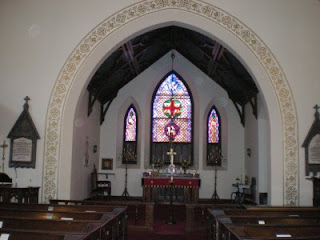
Here are some nice shots of the interior of St. Peter's Church, Salem, Massachusetts




Alcibiades at age two

Here then is Alcibiades, a good two years old now, waxing strong as the Good Book says. Al is especially fond of Joshua, a squeaky plastic toy or a ball, treats and ice cubes. He loves going down to the batting cage at Palmer Cove and fetching his toy, but has yet to master the art of returning it to his master. To call Joshua or me a "master" in this context is still something of a misnomer. Al, like many of us, has an independent turn of mind.
Monday, July 14, 2008
Readings for July 20th
The readings for the coming Sunday include the famous story of Jacob's wrestling with the Angel of God.
The Psalm celebrates God's intimate knowledge of each of us entirely as we are in our humanity.
Paul continues his discussion of our living out our lives in the flesh versus our life in the spirit. He concludes that the sufferings we now endure bear no comparison with the Glory that shall be reavealed...a notion worth considering!
And Jesus presents the parable of the wheat and the tares.
Now, I ask you how shall a preacher attack those three readings???
Any ideas???
Fr. Paul
Almighty God, the fountain of all wisdom, you know our necessities before we ask and our ignorance in asking: Have compassion on our weakness, and mercifully give us those things which for our unworthiness we dare not, and for our blindness we cannot ask; through the worthiness of your Son Jesus Christ our Lord, who lives and reigns with you and the Holy Spirit, one God, now and for ever. Amen.
Genesis 28:10-19a
Jacob left Beer-sheba and went toward Haran. He came to a certain place and stayed there for the night, because the sun had set. Taking one of the stones of the place, he put it under his head and lay down in that place. And he dreamed that there was a ladder set up on the earth, the top of it reaching to heaven; and the angels of God were ascending and descending on it. And the LORD stood beside him and said, "I am the LORD, the God of Abraham your father and the God of Isaac; the land on which you lie I will give to you and to your offspring; and your offspring shall be like the dust of the earth, and you shall spread abroad to the west and to the east and to the north and to the south; and all the families of the earth shall be blessed in you and in your offspring. Know that I am with you and will keep you wherever you go, and will bring you back to this land; for I will not leave you until I have done what I have promised you." Then Jacob woke from his sleep and said, "Surely the LORD is in this place-- and I did not know it!" And he was afraid, and said, "How awesome is this place! This is none other than the house of God, and this is the gate of heaven."
So Jacob rose early in the morning, and he took the stone that he had put under his head and set it up for a pillar and poured oil on the top of it. He called that place Bethel.
Psalm 139: 1-11, 22-23 Page 794, BCP
Domine, probasti
1
LORD, you have searched me out and known me; *
you know my sitting down and my rising up;
you discern my thoughts from afar.
2
You trace my journeys and my resting-places *
and are acquainted with all my ways.
3
Indeed, there is not a word on my lips, *
but you, O LORD, know it altogether.
4
You press upon me behind and before *
and lay your hand upon me.
5
Such knowledge is too wonderful for me; *
it is so high that I cannot attain to it.
6
Where can I go then from your Spirit? *
where can I flee from your presence?
7
If I climb up to heaven, you are there; *
if I make the grave my bed, you are there also.
8
If I take the wings of the morning *
and dwell in the uttermost parts of the sea,
9
Even there your hand will lead me *
and your right hand hold me fast.
10
If I say, "Surely the darkness will cover me, *
and the light around me turn to night,"
11
Darkness is not dark to you;
the night is as bright as the day; *
darkness and light to you are both alike.
22
Search me out, O God, and know my heart; *
try me and know my restless thoughts.
23
Look well whether there be any wickedness in me *
and lead me in the way that is everlasting.
Romans 8:12-25
Brothers and sisters, we are debtors, not to the flesh, to live according to the flesh-- for if you live according to the flesh, you will die; but if by the Spirit you put to death the deeds of the body, you will live. For all who are led by the Spirit of God are children of God. For you did not receive a spirit of slavery to fall back into fear, but you have received a spirit of adoption. When we cry, "Abba! Father!" it is that very Spirit bearing witness with our spirit that we are children of God, and if children, then heirs, heirs of God and joint heirs with Christ-- if, in fact, we suffer with him so that we may also be glorified with him.
I consider that the sufferings of this present time are not worth comparing with the glory about to be revealed to us. For the creation waits with eager longing for the revealing of the children of God; for the creation was subjected to futility, not of its own will but by the will of the one who subjected it, in hope that the creation itself will be set free from its bondage to decay and will obtain the freedom of the glory of the children of God. We know that the whole creation has been groaning in labor pains until now; and not only the creation, but we ourselves, who have the first fruits of the Spirit, groan inwardly while we wait for adoption, the redemption of our bodies. For in hope we were saved. Now hope that is seen is not hope. For who hopes for what is seen? But if we hope for what we do not see, we wait for it with patience.
Matthew 13:24-30,36-43
Jesus put before the crowd another parable: "The kingdom of heaven may be compared to someone who sowed good seed in his field; but while everybody was asleep, an enemy came and sowed weeds among the wheat, and then went away. So when the plants came up and bore grain, then the weeds appeared as well. And the slaves of the householder came and said to him, `Master, did you not sow good seed in your field? Where, then, did these weeds come from?' He answered, `An enemy has done this.' The slaves said to him, `Then do you want us to go and gather them?' But he replied, `No; for in gathering the weeds you would uproot the wheat along with them. Let both of them grow together until the harvest; and at harvest time I will tell the reapers, Collect the weeds first and bind them in bundles to be burned, but gather the wheat into my barn.'"
Then he left the crowds and went into the house. And his disciples approached him, saying, "Explain to us the parable of the weeds of the field." He answered, "The one who sows the good seed is the Son of Man; the field is the world, and the good seed are the children of the kingdom; the weeds are the children of the evil one, and the enemy who sowed them is the devil; the harvest is the end of the age, and the reapers are angels. Just as the weeds are collected and burned up with fire, so will it be at the end of the age. The Son of Man will send his angels, and they will collect out of his kingdom all causes of sin and all evildoers, and they will throw them into the furnace of fire, where there will be weeping and gnashing of teeth. Then the righteous will shine like the sun in the kingdom of their Father. Let anyone with ears listen!"
Wednesday, July 09, 2008
Invitation to Governor Patrick

The following language articulates the invitation I extended to the Governor last night...a bit florid I'll grant you, but still....of the sort one would expect from a "state occasion". Here too is a nice shot of the Governor signing a copy of the invitation we extended to him to occupy the "Governor's Pew
Fr. Paul
The Governor’s Pew
During the American Revolution, when it became dangerous for the British Governor of the Massachusetts Bay Colony to govern or live in
During that time, St. Peter’s Church became the “official”
We were then under the British Crown. There was enmity between brothers and sisters because of religious conviction. Slavery was commonly practiced and slaves were permitted only in the balcony of this church for a time.
In succeeding years, in the crucible of history we have enshrined the idea of the separation of Church and State in the Constitution. We have abolished slavery and have worked diligently for the cause of Civil Rights. This Church has also striven for equality and human rights for all without regard to race, ethnicity, gender or orientation.
And now in honor of this congregation’s 275th Anniversary we, the Priest, Wardens and Vestry of St. Peter’s Church, Salem invite you, The Honorable Deval Patrick, Governor of the Free and Sovereign Commonwealth of Massachusetts, to occupy the “Governor’s Pew” as a sign of the universal freedoms for which a free people stand.
Governor Patrick Visits St. Peter's
The following article appears on the front page of today's Salem Evening News.
What a wonderful day for St. Peter's.
Governor's visit to venerable St. Peter's makes history
By Chris CassidyStaff writer
SALEM — The last time a governor walked into St. Peter's Episcopal Church, he faced the threat of being spit on. Yesterday, a much friendlier assembly greeted Gov. Deval Patrick, who paid a visit to this downtown church celebrating its 275th anniversary. "This crowd wouldn't do a thing like that," the Rev. Paul Bresnahan told Patrick after he shook hands with the 25 or so parishioners at the church. Patrick walked inside to discover he had his very own pew waiting for him — The State Pew — at one time occupied by one of the region's least-popular governors. It's a seat with a lot of history. In 1774, tensions in Boston ignited to the point where the royal governor, Gen. Thomas Gage, fled to Salem for his own safety. While in Salem, Gage attended church services at St. Peter's, and his seat became known as The State Pew. But St. Peter's was affiliated with the Church of England, making it a popular target for the rebels who wanted the British out. "We were on the wrong side of the Revolutionary War," said lifelong parishioner Virginia Lavoie. It grew so bad that a church member was assigned to keep an eye on the balcony, where patriots would spit on parishioners during worship. Its British emblem still intact, the pew has never been occupied by another governor until Patrick visited yesterday. "It wouldn't do to ask you to update the coat of arms?" Patrick joked. Bresnahan invited Patrick to the church to commemorate its 275th anniversary, and Patrick spent about 15 minutes here before hosting a town hall-style meeting at Armory Park. "It really shows (Bresnahan) has been aggressively trying to increase the visibility of the church," parishioner Robert McHugh said. "He's a tireless guy, and we're quite thrilled." "It's wonderful," said Heidi Milman, a parishioner for more than 40 years. "It's a lot of recognition for the church. ... We're very proud of our anniversary." Staff writer Chris Cassidy can be reached at ccassidy@salemnews.com.
Photos

Matt Viglianti/Staff photo

Matt Viglianti/Staff photo
Sunday, July 06, 2008
A Sower Went Our to Sow
Next week, July 13, the following readings will meet us on Sunday morning. Perhaps we can learn together what it means for God's Word to be a "lantern unto our feet"...as the sower goes out to sow...
Collect of the Day for July 13, 2008
O Lord, mercifully receive the prayers of your people who call upon you, and grant that they may know and understand what things they ought to do, and also may have grace and power faithfully to accomplish them; through Jesus Christ our Lord, who lives and reigns with you and the Holy Spirit, one God, now and for ever. Amen.
Genesis 25:19-34
These are the descendants of Isaac, Abraham's son: Abraham was the father of Isaac, and Isaac was forty years old when he married Rebekah, daughter of Bethuel the Aramean of Paddan-aram, sister of Laban the Aramean. Isaac prayed to the LORD for his wife, because she was barren; and the LORD granted his prayer, and his wife Rebekah conceived. The children struggled together within her; and she said, "If it is to be this way, why do I live?" So she went to inquire of the LORD. And the LORD said to her,
"Two nations are in your womb,
and two peoples born of you shall be divided;
the one shall be stronger than the other,
the elder shall serve the younger."
When her time to give birth was at hand, there were twins in her womb. The first came out red, all his body like a hairy mantle; so they named him Esau. Afterward his brother came out, with his hand gripping Esau's heel; so he was named Jacob. Isaac was sixty years old when she bore them.
When the boys grew up, Esau was a skillful hunter, a man of the field, while Jacob was a quiet man, living in tents. Isaac loved Esau, because he was fond of game; but Rebekah loved Jacob.
Once when Jacob was cooking a stew, Esau came in from the field, and he was famished. Esau said to Jacob, "Let me eat some of that red stuff, for I am famished!" (Therefore he was called Edom.) Jacob said, "First sell me your birthright." Esau said, "I am about to die; of what use is a birthright to me?" Jacob said, "Swear to me first." So he swore to him, and sold his birthright to Jacob. Then Jacob gave Esau bread and lentil stew, and he ate and drank, and rose and went his way. Thus Esau despised his birthright.
105
Your word is a lantern to my feet *
and a light upon my path.
106
I have sworn and am determined *
to keep your righteous judgments.
107
I am deeply troubled; *
preserve my life, O LORD, according to your word.
108
Accept, O LORD, the willing tribute of my lips, *
and teach me your judgments.
109
My life is always in my hand, *
yet I do not forget your law.
110
The wicked have set a trap for me, *
but I have not strayed from your commandments.
111
Your decrees are my inheritance for ever; *
truly, they are the joy of my heart.
112
I have applied my heart to fulfill your statutes *
for ever and to the end.
Romans 8:1-11
There is no condemnation for those who are in Christ Jesus. For the law of the Spirit of life in Christ Jesus has set you free from the law of sin and of death. For God has done what the law, weakened by the flesh, could not do: by sending his own Son in the likeness of sinful flesh, and to deal with sin, he condemned sin in the flesh, so that the just requirement of the law might be fulfilled in us, who walk not according to the flesh but according to the Spirit. For those who live according to the flesh set their minds on the things of the flesh, but those who live according to the Spirit set their minds on the things of the Spirit. To set the mind on the flesh is death, but to set the mind on the Spirit is life and peace. For this reason the mind that is set on the flesh is hostile to God; it does not submit to God's law-- indeed it cannot, and those who are in the flesh cannot please God.
But you are not in the flesh; you are in the Spirit, since the Spirit of God dwells in you. Anyone who does not have the Spirit of Christ does not belong to him. But if Christ is in you, though the body is dead because of sin, the Spirit is life because of righteousness. If the Spirit of him who raised Jesus from the dead dwells in you, he who raised Christ from the dead will give life to your mortal bodies also through his Spirit that dwells in you.
Matthew 13:1-9,18-23
Jesus went out of the house and sat beside the sea. Such great crowds gathered around him that he got into a boat and sat there, while the whole crowd stood on the beach. And he told them many things in parables, saying: "Listen! A sower went out to sow. And as he sowed, some seeds fell on the path, and the birds came and ate them up. Other seeds fell on rocky ground, where they did not have much soil, and they sprang up quickly, since they had no depth of soil. But when the sun rose, they were scorched; and since they had no root, they withered away. Other seeds fell among thorns, and the thorns grew up and choked them. Other seeds fell on good soil and brought forth grain, some a hundredfold, some sixty, some thirty. Let anyone with ears listen!"
"Hear then the parable of the sower. When anyone hears the word of the kingdom and does not understand it, the evil one comes and snatches away what is sown in the heart; this is what was sown on the path. As for what was sown on rocky ground, this is the one who hears the word and immediately receives it with joy; yet such a person has no root, but endures only for a while, and when trouble or persecution arises on account of the word, that person immediately falls away. As for what was sown among thorns, this is the one who hears the word, but the cares of the world and the lure of wealth choke the word, and it yields nothing. But as for what was sown on good soil, this is the one who hears the word and understands it, who indeed bears fruit and yields, in one case a hundredfold, in another sixty, and in another thirty."
A Sower Went Out to Sow
Note here the role of “The Word (Logos) of God. For as the sower goes out to sow, so the word of God finds a home in the human heart. Likewise, as in the psalter, the Word of God becomes a lantern to our feet. In Romans Paul understands that because we live in the spirit we are no longer in the flesh, in a sense and so we come no longer under the law, but under the authority of the Word of God. The story of Jacob and Esau and the selling of the birthright (or pledge of “word”) between two brothers…is of great interest Thus next week we are invited by the lectionary to consider the Word of God…and our word to one another as central to the ordering of our common life.
I came across a few thoughts with regard to "the word". I shared them on Sunday and several folk asked for copies of what I said; Here then, a few simple thoughts:
Illustrations #1
God spoke and it was so. God spoke simply: Let there be light. Let us make humankind. Jesus spoke with similar simplicity; “Love one another”. It really is as simple as that. Churchill summarizes well, the power of a single word: “All the great things are simple, and many can be expressed in a single word: freedom; justice; honor; duty; mercy; hope”
Illustration #2
Years ago I heard an old saying that has stuck with me through the years. It is one of those sayings that takes the same words, and rearranges them slightly to make an unforgettable point: the one to which I refer is; “I shall not live till I have seen God, and when I have seen God I shall never die!”
Illustration #3
Some say God is silent! Not so.
The Scripture is the Word of God, and has much to say. In the prologue to John’s great Gospel, Jesus is the Word of God made flesh, and Jesus is a never ending word of love in my heart. And according to Meister Eckhart: “Every creature is a Word of God”.
What a marvel that God is so articulate when so often so many cannot hear a word of God.
Collect of the Day for July 13, 2008
O Lord, mercifully receive the prayers of your people who call upon you, and grant that they may know and understand what things they ought to do, and also may have grace and power faithfully to accomplish them; through Jesus Christ our Lord, who lives and reigns with you and the Holy Spirit, one God, now and for ever. Amen.
Genesis 25:19-34
These are the descendants of Isaac, Abraham's son: Abraham was the father of Isaac, and Isaac was forty years old when he married Rebekah, daughter of Bethuel the Aramean of Paddan-aram, sister of Laban the Aramean. Isaac prayed to the LORD for his wife, because she was barren; and the LORD granted his prayer, and his wife Rebekah conceived. The children struggled together within her; and she said, "If it is to be this way, why do I live?" So she went to inquire of the LORD. And the LORD said to her,
"Two nations are in your womb,
and two peoples born of you shall be divided;
the one shall be stronger than the other,
the elder shall serve the younger."
When her time to give birth was at hand, there were twins in her womb. The first came out red, all his body like a hairy mantle; so they named him Esau. Afterward his brother came out, with his hand gripping Esau's heel; so he was named Jacob. Isaac was sixty years old when she bore them.
When the boys grew up, Esau was a skillful hunter, a man of the field, while Jacob was a quiet man, living in tents. Isaac loved Esau, because he was fond of game; but Rebekah loved Jacob.
Once when Jacob was cooking a stew, Esau came in from the field, and he was famished. Esau said to Jacob, "Let me eat some of that red stuff, for I am famished!" (Therefore he was called Edom.) Jacob said, "First sell me your birthright." Esau said, "I am about to die; of what use is a birthright to me?" Jacob said, "Swear to me first." So he swore to him, and sold his birthright to Jacob. Then Jacob gave Esau bread and lentil stew, and he ate and drank, and rose and went his way. Thus Esau despised his birthright.
Psalm 119:105-112 Page 772, BCP
105
Your word is a lantern to my feet *
and a light upon my path.
106
I have sworn and am determined *
to keep your righteous judgments.
107
I am deeply troubled; *
preserve my life, O LORD, according to your word.
108
Accept, O LORD, the willing tribute of my lips, *
and teach me your judgments.
109
My life is always in my hand, *
yet I do not forget your law.
110
The wicked have set a trap for me, *
but I have not strayed from your commandments.
111
Your decrees are my inheritance for ever; *
truly, they are the joy of my heart.
112
I have applied my heart to fulfill your statutes *
for ever and to the end.
Romans 8:1-11
There is no condemnation for those who are in Christ Jesus. For the law of the Spirit of life in Christ Jesus has set you free from the law of sin and of death. For God has done what the law, weakened by the flesh, could not do: by sending his own Son in the likeness of sinful flesh, and to deal with sin, he condemned sin in the flesh, so that the just requirement of the law might be fulfilled in us, who walk not according to the flesh but according to the Spirit. For those who live according to the flesh set their minds on the things of the flesh, but those who live according to the Spirit set their minds on the things of the Spirit. To set the mind on the flesh is death, but to set the mind on the Spirit is life and peace. For this reason the mind that is set on the flesh is hostile to God; it does not submit to God's law-- indeed it cannot, and those who are in the flesh cannot please God.
But you are not in the flesh; you are in the Spirit, since the Spirit of God dwells in you. Anyone who does not have the Spirit of Christ does not belong to him. But if Christ is in you, though the body is dead because of sin, the Spirit is life because of righteousness. If the Spirit of him who raised Jesus from the dead dwells in you, he who raised Christ from the dead will give life to your mortal bodies also through his Spirit that dwells in you.
Matthew 13:1-9,18-23
Jesus went out of the house and sat beside the sea. Such great crowds gathered around him that he got into a boat and sat there, while the whole crowd stood on the beach. And he told them many things in parables, saying: "Listen! A sower went out to sow. And as he sowed, some seeds fell on the path, and the birds came and ate them up. Other seeds fell on rocky ground, where they did not have much soil, and they sprang up quickly, since they had no depth of soil. But when the sun rose, they were scorched; and since they had no root, they withered away. Other seeds fell among thorns, and the thorns grew up and choked them. Other seeds fell on good soil and brought forth grain, some a hundredfold, some sixty, some thirty. Let anyone with ears listen!"
"Hear then the parable of the sower. When anyone hears the word of the kingdom and does not understand it, the evil one comes and snatches away what is sown in the heart; this is what was sown on the path. As for what was sown on rocky ground, this is the one who hears the word and immediately receives it with joy; yet such a person has no root, but endures only for a while, and when trouble or persecution arises on account of the word, that person immediately falls away. As for what was sown among thorns, this is the one who hears the word, but the cares of the world and the lure of wealth choke the word, and it yields nothing. But as for what was sown on good soil, this is the one who hears the word and understands it, who indeed bears fruit and yields, in one case a hundredfold, in another sixty, and in another thirty."
A Sower Went Out to Sow
Note here the role of “The Word (Logos) of God. For as the sower goes out to sow, so the word of God finds a home in the human heart. Likewise, as in the psalter, the Word of God becomes a lantern to our feet. In Romans Paul understands that because we live in the spirit we are no longer in the flesh, in a sense and so we come no longer under the law, but under the authority of the Word of God. The story of Jacob and Esau and the selling of the birthright (or pledge of “word”) between two brothers…is of great interest Thus next week we are invited by the lectionary to consider the Word of God…and our word to one another as central to the ordering of our common life.
I came across a few thoughts with regard to "the word". I shared them on Sunday and several folk asked for copies of what I said; Here then, a few simple thoughts:
Illustrations #1
God spoke and it was so. God spoke simply: Let there be light. Let us make humankind. Jesus spoke with similar simplicity; “Love one another”. It really is as simple as that. Churchill summarizes well, the power of a single word: “All the great things are simple, and many can be expressed in a single word: freedom; justice; honor; duty; mercy; hope”
Illustration #2
Years ago I heard an old saying that has stuck with me through the years. It is one of those sayings that takes the same words, and rearranges them slightly to make an unforgettable point: the one to which I refer is; “I shall not live till I have seen God, and when I have seen God I shall never die!”
Illustration #3
Some say God is silent! Not so.
The Scripture is the Word of God, and has much to say. In the prologue to John’s great Gospel, Jesus is the Word of God made flesh, and Jesus is a never ending word of love in my heart. And according to Meister Eckhart: “Every creature is a Word of God”.
What a marvel that God is so articulate when so often so many cannot hear a word of God.
Wednesday, June 25, 2008
Something New
Hi folks,
As we prepare to celebrate our congregation's 275th anniversary I thought we'd try something just a little different. So to add a little life to this blog, let's get into the habit of sharing with you the readings for the coming Sunday. This will help us "get ready" for church by reading what the lectionary wants us to read ahead of time. We can then begin to form our questions about what the scripture is saying to us in our own hearts and then perhaps share some of that with our friends at Church on Sunday. For those of us at St. Peter's we can use some of this material as a basis for conversation at "Coffee Plus" after church.
Here then are the readings for this coming Sunday.
The Seventh Sunday After Pentecost
June 29th.
The Parish Picnic at Winter Park
275 Years to the Day from the Founding of St. Peter's, Salem
Collect of the Day
Almighty God, you have built your Church upon the foundation of the apostles and prophets, Jesus Christ himself being the chief cornerstone: Grant us so to be joined together in unity of spirit by their teaching, that we may be made a holy temple acceptable to you; through Jesus Christ our Lord, who lives and reigns with you and the Holy Spirit, one God, for ever and ever. Amen.
Old Testament Reading:Genesis 22:1-14
God tested Abraham. He said to him, "Abraham!" And he said, "Here I am." He said, "Take your son, your only son Isaac, whom you love, and go to the land of Moriah, and offer him there as a burnt offering on one of the mountains that I shall show you." So Abraham rose early in the morning, saddled his donkey, and took two of his young men with him, and his son Isaac; he cut the wood for the burnt offering, and set out and went to the place in the distance that God had shown him. On the third day Abraham looked up and saw the place far away. Then Abraham said to his young men, "Stay here with the donkey; the boy and I will go over there; we will worship, and then we will come back to you." Abraham took the wood of the burnt offering and laid it on his son Isaac, and he himself carried the fire and the knife. So the two of them walked on together. Isaac said to his father Abraham, "Father!" And he said, "Here I am, my son." He said, "The fire and the wood are here, but where is the lamb for a burnt offering?" Abraham said, "God himself will provide the lamb for a burnt offering, my son." So the two of them walked on together.
When they came to the place that God had shown him, Abraham built an altar there and laid the wood in order. He bound his son Isaac, and laid him on the altar, on top of the wood. Then Abraham reached out his hand and took the knife to kill his son. But the angel of the LORD called to him from heaven, and said, "Abraham, Abraham!" And he said, "Here I am." He said, "Do not lay your hand on the boy or do anything to him; for now I know that you fear God, since you have not withheld your son, your only son, from me." And Abraham looked up and saw a ram, caught in a thicket by its horns. Abraham went and took the ram and offered it up as a burnt offering instead of his son. So Abraham called that place "The LORD will provide"; as it is said to this day, "On the mount of the LORD it shall be provided."
Psalm 13 Page 597, Book of Common Prayer
1
How long, O LORD?
will you forget me for ever? *
how long will you hide your face from me?
2
How long shall I have perplexity in my mind,
and grief in my heart, day after day?*
how long shall my enemy triumph over me?
3
Look upon me and answer me, O LORD my God; *
give light to my eyes, lest I sleep in death;
4
Lest my enemy say, "I have prevailed over him," *
and my foes rejoice that I have fallen.
5
But I put my trust in your mercy; *
my heart is joyful because of your saving help.
6
I will sing to the LORD, for he has dealt with me richly; *
I will praise the Name of the Lord Most High.
Epistle: Romans 6:12-23
Do not let sin exercise dominion in your mortal bodies, to make you obey their passions. No longer present your members to sin as instruments of wickedness, but present yourselves to God as those who have been brought from death to life, and present your members to God as instruments of righteousness. For sin will have no dominion over you, since you are not under law but under grace.
What then? Should we sin because we are not under law but under grace? By no means! Do you not know that if you present yourselves to anyone as obedient slaves, you are slaves of the one whom you obey, either of sin, which leads to death, or of obedience, which leads to righteousness? But thanks be to God that you, having once been slaves of sin, have become obedient from the heart to the form of teaching to which you were entrusted, and that you, having been set free from sin, have become slaves of righteousness. I am speaking in human terms because of your natural limitations. For just as you once presented your members as slaves to impurity and to greater and greater iniquity, so now present your members as slaves to righteousness for sanctification.
When you were slaves of sin, you were free in regard to righteousness. So what advantage did you then get from the things of which you now are ashamed? The end of those things is death. But now that you have been freed from sin and enslaved to God, the advantage you get is sanctification. The end is eternal life. For the wages of sin is death, but the free gift of God is eternal life in Christ Jesus our Lord.
Gospel: Matthew 10:40-42
Jesus said, "Whoever welcomes you welcomes me, and whoever welcomes me welcomes the one who sent me. Whoever welcomes a prophet in the name of a prophet will receive a prophet's reward; and whoever welcomes a righteous person in the name of a righteous person will receive the reward of the righteous; and whoever gives even a cup of cold water to one of these little ones in the name of a disciple-- truly I tell you, none of these will lose their reward."
There now...have questions...???
See you Sunday...or if you just happen to come across this blog, don't hesitate to leave a comment, or email me.
Blessings on all,
Fr. Paul
Monday, May 12, 2008
The Strong Name of the Trinity!
Trinity Sunday is among my favorite days of the Christian year...here follow a few thoughts for Trinity Sunday...I bind unto myself the strong name of the Trinity!
Paul of Salem.
Response for Trinity Sunday.
Where are we to get strength to face the challenge of our times? History brings us many challenges. Our ancestors in faith demonstrated great courage in the face of adversity. We too can come to the wellspring of courage they drew from. I am devoted to the notion of the Trinity, not as a doctrine but as to the source of a God given spirituality. There is great power in that spirituality.
We know that God “brooded” over the face of the waters of chaos at the creation. We also know that Jesus poured out his life for us on the cross. And we have reliable witnesses who told us about the experience of a “mighty wind” that rushed in upon the Apostles in the Upper Room, and the flames of fire that alighted upon them. Thus the biblical record clearly states that God is Creator, Redeemer, and Sanctifier. In Sacred History our collective experience of God’s mighty power is called The Holy Trinity in short hand. This is no doctrine for me. This is the very power of God, and we have direct experience of it and access to it.
Thus there are terrorist attacks the like of which we have never seen before, and there will be more to follow. Nature will unleash her destructive forces in unprecedented dimensions particularly if we continue to ignore our own contribution to nature’s need for protection and conservation. Garden variety human sin as well as sin of a more heinous sort, political chicanery, and economic disquietude will often find us overwhelmed by the sheer magnitude of it all.
But we must not despair. And we must never loose hope. We have in fact, seen it all before. We must read our history books. If we do not, we will repeat it all, time after time after tiresome time. The philosopher, George Santayana said it well; “Those who forget the past are condemned to repeat it!”
Whatever the world throws at us by way of human violence, nature’s fury, or our own folly, we still have won the Victory! That is the core of our faith. Good Friday will have its day. But Good Friday is not the end of the story. If that had been the end of the story for us, Christianity would have been nothing more than a byword. “Ho-hum, another good man died at the hands of brutality”, history would say by way of footnote.
But Jesus and Christianity is no footnote, and we had better wake up to the fact that God is not to be mocked, either by wicked people, or by our own timidity. God is nothing short of the power to redeem a fallen world. We are the Easter People, remember! It is time for us to get our nerve back and put some punch back into our Gospel. We are the hands and feet of the Gospel…and whatever catastrophe befalls us, we have much work to do.
There is a wonderful scene in “Fiddler on the Roof”. In it, the Great Wedding Feast is utterly destroyed by Cossack soldiers descending upon the merry making. Homes are set afire, tables overturned, china broken, and the entire scene is pillaged. In shock, in disbelief, the people look up to God in bewilderment…and ask Tevye, who always had something wise to say; “What are we to do now?” There was, of course a long pause, as Tevye resolutely picked up a chair, and defiantly said; “Clean up the mess”.
Tevye also wondered about being the “Chosen” people…by asking God at one point with a wry smile: “Couldn’t you choose somebody else, once in a while?” My dear friends, there is a futility in asking “why” to the constant onslaught of sin. It is understandable, but ultimately futile. What is much more fruitful will be Tevye’s faithful response to the experience of devastation. What we have to remember after 9/11, or after the onslaught of Tsunamis, Hurricanes and Cyclones, what we have to remember after our own sins, or the sins and wickedness of others; is the simple but Grace-filled proclamation; “Clean up the mess!”
Wonder of wonders, this is where God’s grace will be found; and more than that, this is where Christ’s Victory will be found. When we claim the Power of God to Create, To Save and to Sanctify, all the world will see that the Love of God is alive and well in us. As we dare to be the hands and feet of Jesus in this world, we will discover God’s Grace at work in us transforming us and the world we live in.
All the world will come to taste and see the Creative, Redeeming and Sanctifying Power of God as we remember who God has called us to be. I am not the first Celt to bind to myself the Strong Name of the Trinity. Patrick did so many, many years ago during his battle with the Irish slave trade. Bind yourself to it with me and all those who have looked to God for help before, you will no doubt discover the Power of God at work in you!
Peace Pentecost
Pentecost was a wonderful day at St. Peter's. The Gospel was read in six languages: English, German, Spanish, French, Greek, and Swahili...it was wonderful! And Mamadou, a new friend of the parish from Senegal, played the West African drums for us and rendered our music and our praise expecially joyful and exciting! What a day...and then marching "In the Light of God" we made our way to the Parish Hall where we feasted on a sumptuous Birthday Cake for the Church...
(The Following is what I based my sermon on for Pentecost)
Peace Pentecost!
To this day, people of faith greet one another “Shalom”, “salaam alaykum”, and of course the Christians say “Peace”. The root of the word “Jerusalem” means “Peace”, and is thus viewed as the Holy City. We say peace…but do we mean it?
As recently as today there is division, there is warfare. Can we transcend race, ethnicity and sexual politics? Will the measure of our wealth or the lack of it continue to divide or classify us? We are still, as it were, “Parthians, Medes, Elamites, and residents of Mesopotamia, Judea and Cappadocia, Pontus and Asia, Phrygia and Pamphylia, Egypt and the parts of Libya belonging to Cyrene, and visitors from Rome, both Jews and proselytes, Cretans and Arabs”. All that is different in the dynamic of definition are the labels we use because now we are black, white, rich, poor, gay, straight, Arab, Jew, Protestant, Catholic, and every ethnicity under the sun. And if we listen to the “still small voice of God” we’ll hear that Gospel message making us all ONE in Christ. Today let us pray for the Pentecost moment that it may alight upon us once again.
Cowering in fear in the Upper Room, they were…and then Jesus came to them. “Peace be unto you”, he says and then he repeats it. The room is filled with the sound of a mighty rush of wind. Flames appear over their heads and they are filled to the brim with the power and the goodness of God. And going forth then they speak the languages of a thousand tongues. Every division that humanity had known fell before breath of the Holy Spirit. They received Power when the Holy Spirit came upon them, and they became witnesses for Christ unto the uttermost parts of the earth. (para. Acts 1:8)
It is so easy for us to classify human beings into every kind of convenient box. But then Jesus happens and all our sad divisions cease. When we allow Jesus to be the Christ, and when we find ourselves “in him” we are then no longer male nor female, Jew nor Greek, slave nor free, for we are all one in Christ. (Galatians 3:28)
Suddenly we are at Peace when we are living a Baptized life. In the Prayer Book Service the question is asked of the newly baptized; “Will you respect the dignity of every human being?” That really is an utterly astounding expectation. The Baptismal Covenant requires as much, however.
The Pentecost event proclaims that the Holy Spirit has been poured out on the whole creation. It is a curious irony that Sunday morning is still the most segregated hour of the week. We have yet to fully embrace the power that Christ has poured out on us.
I suspect that when the world sees us so divided into all of our racial, ethnic, and economic pigeonholes, some of the power of our Gospel looses its impact. That impact will weaken us until all our sad divisions cease.
I cannot help but think of my mother on this day. It is not just Pentecost, it is Mother’s Day as well. When we said our prayers at night, my Mother, not a particularly religious woman, would sit with me by my bed at night. I’d kneel beside my bed and say my prayers. At the end of those prayers we would say the “God blesses…” “God bless mommy, and daddy. God bless grandma and grandpa, God bless the cat and the dog, and God bless my brother Bobby” (that was a hard one…) and then we’d say something extraordinary; “God bless everybody in the whole wide world. Amen”.
What my mother taught me quite by accident, I think was to wince just a bit when asking God’s blessing on anything less that everything and everyone. If we choose to ask God to bless this nation, the Pentecost moment is also asking us to bless every nation. If we love our own, we are asked to bless our enemies as well. Pentecost is a very generous and magnanimous moment.
Again on Mother’s Day, I would like to remember my grandmother for just a moment. When Thanksgiving Day came around once a year, she would get on the phone and call all the uncles and cousins and she would press them to into coming to the old family homestead for the holiday. After much grousing, they would relent. We would gather. We would be one, There would be gales of laughter, grand storytelling, a fair amount of gossip and general agreement that we should do this sort of thing more often. My grandmother was the glue that held us together as a family. When she died so did the “extended” family. We waited till funerals and weddings after that to gather.
Jesus I would submit to you is the “glue” that holds us all together as God’s family. Pentecost is the power of Jesus in the resurrection to pour out the spirit of God to gather us together to be one. In Pentecost we speak and we understand all cultures, all languages, all races, all ethnic folks, male, female, gay, straight, rich and poor. If Jesus is alive then we are all one. If we are not one, then Jesus cannot truly live in us. Peace comes to us in the living of Jesus. The Holy Spirit descends on us and turns our souls toward God and toward one another.
It is truly a lifelong task to work out the details of our salvation. Thankfully God has given us a lifetime to do that very work. We have been given the ministry of reconciliation. The fires of the Holy Spirit hover above us not all that far away. When God chases away our fears, we will then realize how close we are to God; how close we are to one another.
Come Holy Spirit, come!
Tuesday, April 29, 2008
Thoughts for Ascensiontide
* * *
In thinking about the ascension of Jesus, we can fall victim to a simplistic cosmology where heaven is "up there" and hell is "down there"... as if one can locate the holy and the profane geographically. Shakespeare also challenges the notion of a then-prevalent cosmology... particularly astrological notions of the influence of stars, constellations, moons, and suns over human behavior. Thus, these words find their way into the mouth of Edmond, the "out-of-wedlock" son of Gloucester. He asks rather convincingly whether we are responsible for our own behaviors or whether some kind of spherical influences have power to direct our lives:
This is the excellent foppery of the world, that,
when we are sick in fortune, -- often the surfeit
of our own behavior, -- we make guilty of our
disasters the sun, the moon, and the stars: as
if we were villains by necessity; fools by
heavenly compulsion; knaves, thieves, and
treachers, by spherical predominance; drunkards,
liars, and adulterers, by an enforced obedience of
planetary influence; and all that we are evil in,
by a divine thrusting on: an admirable evasion
of whoremaster man, to lay his goatish
disposition to the charge of a star! My
father compounded with my mother under the
dragon's tail; and my nativity was under Ursa
major; so that it follows, I am rough and
lecherous. Tut, I should have been that I am,
had the maidenliest star in the firmament
twinkled on my bastardizing.
-- King Lear, Act 1, Scene 2
To be sure, you will find a horoscope in every newspaper, and lots of us "check it" just for fun... but do we really believe that the stars have such influences. Is the ascension of Jesus merely some kind of geographical event... or is the Bible pointing to something much deeper than that?
* * *
In the biblical tradition, God's nature is revealed always in relationship... in community, as it were. It comes then as no surprise that Jesus would ascend to the right hand of God to judge the living and the dead. God is community... a dynamic community creating, saving, and sanctifying -- Father, Son, and Holy Spirit. God is not a doctrine called the Trinity; God is a dynamic community intimately involved with the world he loves and gave his Son for. Thus, "no man is an island" as John Donne would say; every one of us is a parent, a child, a sister or brother, a colleague... we are all a community of people inextricably woven one to another for good or ill. With the ascension of Jesus to the right hand of God, a decisive challenge has been issued to make that community good!
* * *
It has been said that the more godlike God becomes, the more genuinely human God is; and conversely the more genuinely human we are, the more godlike we too become. Thus, in the wondrous work of the likes of Michelangelo, these kinds of words become possible:
My soul can find no staircase to heaven unless it be through earth's loveliness.
-- Michelangelo
As we mark the ascension of Jesus let us keep in mind the ineffable quality of both heaven and earth and resist the temptation to trivialize either.
Tuesday, March 25, 2008
Everything You Need to Know About Sex...
Everything You Need to Know About Sex
In Order to Get to Heaven
by
Paul B. Bresnahan
Here is a light hearted, whimsical, satire that is dead serious and downright poignant too. This is a book whose eye catching title suggests that it is time for the church and the culture around it to grow up a bit and recognize the facts for what they are. Gay folks are here to stay and they are right smack dab in the middle of our families, workplaces, and yes, even in our churches. Using his own family and his own church as a microcosm, “Fr. Paul”, as he likes to be called, argues that human sexuality is a sacrament that gives all of us an exquisite way to express our love for one another. It is in the nature of things that our sexuality becomes a God given grace for human love to be expressed. For most of us, we’ll do that in a male/female configuration. But not always! From the beginning, there have been LGBT folk in our midst. They have often faced persecution, violence, vilification and marginalization yet they are still very much with us. One of them is now a Bishop in the Episcopal Church. His life has been threatened too (by Christians, of course). Come on folks, let’s get over this one. Let’s embrace yet another minority with the milk of human kindness and in a “kinder gentler” way. Open the book and discover with a Priest of the Church, how we are becoming “A House of Prayer for ALL People”.
Fr. Paul Bresnahan has been a Priest of the Episcopal Church for 35 years. He serves now at St. Peter's Episcopal Church in Salem, Massachusetts, a remarkable congregation that cares very much for the poor, the hungry, the homeless and the marginalized. He has served churches in West Virginia, Ohio, and South Carolina, and now Massachusetts. His lifetime struggle against racism, economic disparity, homelessness now culminates in taking up the cudgels for yet another great group of outcasts. He was raised by a gay uncle, and now has two gay sons. He has a lot to say about this controversy. After all there’s a lot at stake. Best of all, he’s still smiling, because he’s convinced that there’s room in God’s heart for the love of EVERYONE!
available at Amazon.com, Barnes and Noble.com and autographed from the author at paulbresnahan@yahoo.com
Tuesday, March 04, 2008
Double Dawn...a poem
My son Michael gave his senior recital this past weekend...and I flew into Chicago during a vigorous nor'easter and stayed in a hotel overlooking Grant Park...and penned these lines for him by way of a gift in honor of the occasion at daybreak.
Double Dawning
By Paul Bresnahan
A crystal clear blue sky dawned this day
And Chicago stretched out her shoulders
Toward the lake where a frivolous and funny quay
Toppled toward a lakeside lighthouse,
While the hum of traffic glistened in the sun
And buzzed about like bees busy
Even on Sunday at Sunrise.
Articulated busses belched blue diesel
Against a blanket pure with snow
And lovely art is kept cozy and warm
Inside the embrace of the city’s sweet mother museum.
Downtown awakens toward the rising skies
Where stainless steel buildings strain their eyes
To see the blinding glare of morning’s glorious greeting.
Spires and steeples and statues stand about
Everywhere you look and a texture of trees
Bare with branches place themselves in a city park.
It could be said I like a sunny day in Chicago.
But I like Boston too; my home of
Athenian grace that sings symphonicly
Almost any day rabid with Fenway fervor
And painted with a Liberal cobalt blue
Whatever the weather!
Only yesterday, Boston’s blistering snows
De-iced a dark before dawn Airbus 757
And white knuckled me with glee to this toddlin’ town
And the East wind blew me breathless into O’Hare
Half and hour early where music will meet my ear
And a song will sing in my heart.
Perhaps it is life I love that gives me the good sense to stop
Sometimes and breathe and marvel at the miracle
Of a son that sings with a golden tenor tone
Michael!
Can This Church Life Again?
Can This Church Live Again?
Inasmuch as Lazarus was raised from his death by Jesus, so too our aging, dying, and often dead congregations can also live again. A recent study by the Pew Forum on Religion and American Life shows that more than a quarter of adult Americans have migrated from one religious affiliation to another. And too, the current issue of the Atlantic Monthly asks on the cover page “Which Religion Will Win?” It is a time of much soul searching for many an American.
Between politics and religion there certainly is plenty for us to consider in the marketplace of ideas being developed here in the United States and abroad as well. But we seem to be a particularly “religious” nation. We seem to be going through a stage where we are migrating toward a more “conservative” and “evangelical” expression of our faith. But at the same time there is a rediscovery of the Compassionate inclusive Christ by many of our mainline denominations as well.
It is a fascinating time in which to find our way toward God. As I make my way through this time in our shared faith development, what strikes me is just how deeply our young people want to know of their spirituality. They want to “practice the presence of God”, if I may use the phrase Brother Lawrence used so many years ago. And it is not just the young that want to come to know about their journey toward God. Among almost all the folks that have recently visited our congregation, there is a deep and sincere desire to come to know of how the heart of God beats within the heart of each of us.
It is as if almost all by itself, the church is coming back to life from a long and sad slumber. Not long ago, a young man whose life had been marred by misuse of drugs and alcohol came to me seeking help. I turned him toward the Sermon on the Mount and the shortest and earliest of the Gospels: St. Mark. I pointed out that he could read both within an hour. I gave him a copy of the Good News Bible and he read through his assignment and came back to me with amazement and delight in his heart.
“God loves me” he said as if totally blown away by the Bible. But there was so much more to it than that. God loves everyone, he said with bright and beaming joyous eyes. God loves the poor, the outcast, the sinner, the sick, those in prison…he was utterly dumbfounded. I asked him why this surprised him so. He told me that when he watched television evangelists, he heard judgment, condemnation, and anger against the very people the Bible describes as being sought out and loved by Jesus.
It was a total surprise to my new young parishioner. So many of his friends had gotten caught up in drugs, sexual promiscuity, alcohol, and had or were “doing” time. He single-handedly became responsible for bringing many other young people to church, because he was coming to discover that the Good News was that Jesus does indeed love the sinner.
An old dying church was coming back to life again. Lazarus, lives! Another older couple migrated to our congregation from another denomination, because they had a gay uncle and there was a divorced daughter to be loved by Jesus. They found a place where God’s embrace was enfolding people in ever widening circles of inclusivity. And too those with mental and physical disabilities seem to be wandering into the doors of the church as well.
I don’t know for sure just what is going on here, but I will say this; if we stay on message about this all inclusive love of Jesus, and faithfully present the Compassionate One as being the One in whom we place our faith, I believe that there is much life still to be lived in these old churches of ours.
When I was a much younger priest, I was told that God does not ask us to be successful; God is asking us to be faithful. I must confess to you that I am praying for the day when our faithfulness will pay us off with just a little success.
In the meantime, I believe that Jesus is always close by his church and is always calling out for the dying part of us to live again. “Lazarus, come out!” It always amazes me that the power of God is best known at the time of death. My wife recently went to work for Hospice. She reports that she has never worked in a more cheerful setting. Isn’t that amazing when you think of it?
Perhaps this is what Paul meant when he said that “as often as we eat the bread and drink the wine of the Eucharist we show forth the Lord’s death until he comes again.” (I Corinthians 11:26). This may well be the key to our rising again.
May God grant us grace to hear Jesus call out to us; “Lazarus, come out!!
Thursday, December 20, 2007
Red Doors and a Warm Welcome
Hi Everyone,
Well, it was bound to happen. I hit the front page of the Salem News with this fine article. My cousin asked if I was stirring up trouble again...my other cousin said..."not again, but still!"
Peace to all.
Well, it was bound to happen. I hit the front page of the Salem News with this fine article. My cousin asked if I was stirring up trouble again...my other cousin said..."not again, but still!"
Peace to all.

Pastor has door painted red to signify welcoming tradition
Tom Dalton
— SALEM | The massive double door on St. Peter Church is more than 200 years old but had gone largely unnoticed in recent years. Maybe that's because it was green and blended with the leafy surroundings of historic downtown Salem.
When the Rev. Paul Bresnahan, the church's new priest, arrived earlier this year, he was surprised to see a green door. "My wife said to me, 'What happened to the red door?'"
She asked about the color because Episcopal churches traditionally have red doors. It is the color of the blood of Christ and through history has served as a symbol of safety and sanctuary.
But the color red has even more meaning to Bresnahan. It also represents a welcoming church, a church that opens its arms and doors to everyone regardless of race, creed, color or sexual orientation.
That's important to the 61-year-old priest, who is married and has three sons.
"I was brought up by a gay uncle," he said, "and two of my kids are gay."
Sexual orientation might not be a big deal in some churches, but the issue has split the Episcopal church wide open. The headlines started in 2003 with the consecration of V. Gene Robinson as the bishop of New Hampshire -- the first openly gay bishop in the Episcopal Church in the United States.
"We have always ordained gay folks," said Bresnahan, who has been a priest for more than 30 years. "We have always ordained gay bishops, but nobody who would be honest about it. Gene Robinson is the first man who's honest."
Several congregations have seceded from the U.S. Episcopal Church over the growing support for gay rights. Just last week, the Episcopal Diocese of San Joaquin, Calif., voted to leave the church.
There have been Episcopal churches in Massachusetts, including one in Hamilton, that have been torn over the issue, with some members believing that expanding the rights of homosexuals and lesbians within the church is contrary to the teachings of the Bible.
Bresnahan disagrees with that position and, as the father of gay sons, feels so strongly that he wrote a book last year: "Everything You Need to Know About Sex in Order to Get Into Heaven." It is dedicated to his wife and boys.
"Michael, I love you ..." he writes in one dedication, "precisely as you are and whoever you become."
"I have three kids, two of whom happen to be gay," Bresnahan said yesterday, sitting in his office in the old stone church, a photo of his three sons on his desk. "This is no big deal to (me and my wife) ...
"When they came out to me, there was never a question was there room in my heart for the love of them, or in God's heart."
Before coming to Salem, Bresnahan asked the members of St. Peter's to read the book. He wanted them to know about him and his family. It turned out to be no big deal to them either, he said, because St. Peter's is already a welcoming church, which has hosted a gay men's choir.
Although it wasn't his top priority at St. Peter's, Bresnahan said he started discussing the color of the door soon after his arrival. There were some objections, he said, but they had more to do with aesthetics than sex.
Painting the door bright red, he said, was a bow to tradition and the spirit of sanctuary, and also an acknowledgment of where St. Peter's stood at this time of controversy and dissent in the Episcopal church -- where St. Peter's has stood for a long time.
"For me," the new priest said, "it really comes down to the idea of being a house of prayer for all people."
Copyright © 1999-2006 cnhi, inc.
Photos

The Rev. Paul Bresnahan stands in front of St. Peter Church in Salem. The red door symbolizes that all are welcome to the church. Staff Photo
Friday, November 23, 2007
Veteran's Day
This year Veteran's Day fell on a Sunday.
It was a good time to think about all those who have served this country and those who still are.
They find themselves, of course, in conflict now in Iraq and many of them are in harm's way.
Hats off to our veterans.
These are difficult times for our Vets. They serve in dangerous and unfriendly places often not knowing who the friendlies and the enemies are. Telling the difference is problematic.
And so they run patrols and find themselves at the mercy of blind fortune when struck by roadside bombs or coming home safe again. The trauma and stress of this kind of service takes its toll.
The Veteran's Administration tells us that upwards of 30% of the homeless in this country are Veterans and that on any given night 195,000 of them may be on the streets any given night.
We're in for a bunch more homeless if that is any indication when the current crop of men and women in uniform head back from home.
There are those who question the patriotism of people like me who raise questions about some recent wars...especially Viet Nam and now this one...the Second Gulf War.
Both were predicated on lies...yes I said lies.
In the case of Viet Nam it was shown many years later that LBJ trumped up the whole Gulf of Tonkin incident to get Congress to ratify his bellicose policy in South East Asia.
Now we have GWB giving us the line about weapons of mass destruction and Hussein's connection to terrorists to justify sending our country's finest young people into battle.
He did not tell us the truth.
Who would think that the President of the United States would deliberately lie about a matter such as this.
To be sure, Clinton's lie about Lewinsky was reprehensible and a ethical lapse of significance, but in that case, nobody had to die...it was a personal matter for a married couple to resolve and a family to deal with. As difficult as that is, they did it.
But in the case of the Iraq war, we had a deliberate lie that has led to the death of more than 3000 young people and hundreds of thousands of deaths of Iraqi people.
And now we'll have thousands of our young people coming home with terrible wounds in body and spirit and many of them will be homeless.
Many of us have built homeless shelters. I did.
It was not an easy thing to do. People did not want homeless shelters in their neighborhoods.
Homeless people often have mental illnesses, some have alcohol and drug problems.
Many many of them are Veterans.
It is not easy to find a place for them to live.
It is even harder to find money to pay for shelters for them.
It is almost impossible to find the money to pay for the services they need to pay for their rehabilitation.
What kind of country is it that treat's its Veterans so?
And some call me unpatriotic for raising questions about this war.
Yes, we needed to go into Afghanistan and find BinLaden. We still haven't done that.
But it was hasty of us to go into Iraq.
We will pay for that blunder for years.
And so we come to Veteran's Day.
May God bless our young people.
May God protect them.
And may God bring us peace with justice in the Middle East.
So far our Government has been less than effective in moving us toward peace.
Subscribe to:
Posts (Atom)